


September 16, 2026

September 18, 2025
September 10, 2025
July 3, 2025
Core Sector Growth Eases to Three-Month Low of 4.8% in August as Four Sectors Contract

Author
Shoonya Team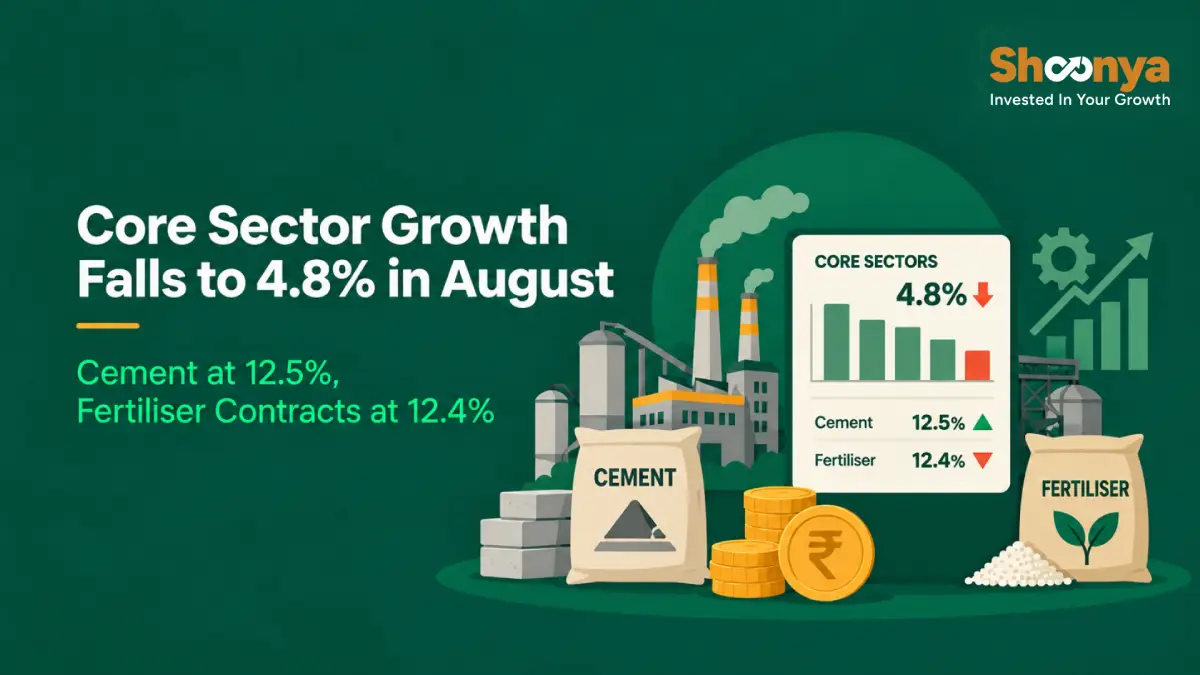
India’s core sector growth eased for the second consecutive month to a three-month low of 4.8% in August, as contractions in coal, natural gas, crude oil, and fertiliser production offset strong performance in cement and electricity. July’s figure was revised downward to 5.0%.
Four of the nine components contracted during the month, while cement and electricity continued to provide most of the support to the overall index.
Sector-Wise Performance in August 2026
| Sector | August 2026 | July 2026 | Direction |
|---|---|---|---|
| Cement | 12.5% | 12.7% | Marginally lower |
| Electricity | 11.6% | 8.4% | Accelerated |
| Steel | 3.4% | 1.9% | Higher but below last year |
| Coal | -3.8% | 7.6% | Contracted |
| Natural Gas | -4.9% | Contraction | Extended decline |
| Crude Oil | -3.6% | Contraction | Continued shrinkage |
| Fertilisers | -12.4% | Contraction | Steepest fall among sectors |
What Drove the Contraction in Energy and Fertiliser Sectors
The restart of the West Asia war affected the energy and fertiliser segments. Weakness was most pronounced across these components:
- Coal production contracted 3.8% after growing 7.6% in July
- Natural gas output fell 4.9%, extending a prolonged contraction
- Crude oil production declined 3.6%, continuing to shrink
- Fertiliser output recorded the steepest fall at 12.4% year-on-year
Iron ore, among the fastest-growing core sector components earlier this year, also lost considerable momentum in August.
Which Sectors Kept Core Output From Falling Further in August?
Cement production grew 12.5% year-on-year, little changed from the 12.7% recorded in July and substantially above the 5.4% expansion seen a year earlier. Electricity generation accelerated to 11.6% from 8.4% in July and 4.2% in August 2025.
Steel production growth remained subdued at 3.4%, higher than July’s 1.9% but sharply below the 15.3% expansion seen in August last year.
The data points to continued strength in construction and infrastructure-linked activity, with cement maintaining double-digit growth and electricity generation staying robust as government capital expenditure continued. Until July, the government had utilised over 36% of its capex target of ₹12.2 lakh crore for FY27, higher than the 30% utilisation achieved during the same period last year.
What ICRA Said About the August Reading?
Rahul Agrawal, Principal Economist at ICRA, said year-on-year growth in core output eased marginally to 4.8% in August 2026 from the downward-revised 5.0% in July 2026, partly on account of an unfavourable base. He said the deceleration was broad-based, with six of the nine sectors reporting a deterioration in performance between the two months.
Rahul Agrawal, Principal Economist, ICRAICRA expects IIP growth to ease to approximately 5.0 to 6.0% in August 2026, down from 6.7% in July 2026.
Final Outlook
August’s data shows a core sector held up by construction-linked segments while energy and fertiliser components stayed under pressure. Whether the West Asia situation eases and domestic gas and crude production recovers will be the key variables shaping the September reading. The August IIP data, when released, will show how broadly the core sector moderation feeds into overall industrial output.
Source: Moneycontrol


Explore Our Offerings

Stocks
Trade equities across NSE and BSE with zero delivery charges. Invest, hold or sell with a seamless experience.


Future & Options
Execute complex strategies with simple tools and real-time data.

IPOs
Apply to the latest IPOs in just a few taps. Stay updated and capture opportunities as they open.