


September 16, 2026

September 18, 2025
September 10, 2025
July 3, 2025
Gold ETF vs. Physical Gold: Which One to Buy This Festive Season?

Author
Shoonya Team
Every Dhanteras, gold finds its way into Indian households. But here’s something worth considering: the price you pay for gold and the value you receive when selling it aren’t always the same.
Physical gold jewellery comes with making charges and possible resale deductions. Gold ETFs avoid jewellery-making charges but involve fund expenses and market-related risks. When comparing Gold ETF vs physical gold, these differences matter.
Let’s understand what you’re actually paying for, how easily you can sell and which option aligns with your purpose.
What are Gold ETFs?
A Gold ETF (Exchange-Traded Fund) is a SEBI-regulated, open-ended mutual fund scheme that pools investor capital to purchase 99.5% pure physical gold bullion.
It aims to track domestic gold prices. Investors can buy and sell ETF units on stock exchanges such as the NSE and BSE through a demat and trading account.
How Do Gold ETFs Work?
Gold ETFs pool investors’ money to invest primarily in physical gold. Investors receive ETF units that track domestic gold prices without requiring them to store gold themselves.
Here’s how Gold ETFs work:
- Investment: Investors purchase Gold ETF units through a demat and trading account.
- Gold Holdings: The fund invests primarily in physical gold, which is stored with an appointed custodian.
- Price Movement: ETF values generally follow domestic gold prices. This is subject to expenses and tracking differences.
- Buying and Selling: Investors can buy or sell units on stock exchanges during market hours. However, this is again subject to liquidity.
- Returns: Investors may earn gains if the ETF’s selling price exceeds their purchase cost. However, losses are also possible.
Pros of Gold ETFs
You can invest in gold without paying jewellery-making charges, arranging storage or worrying about its purity.
Here are the advantages of investing in ETFs –
- It’s easy to convert your investment into cash by selling during market hours.
- Since gold is held by a fund house, there’s no need for physical storage or fear of theft.
- Every unit of a Gold ETF is backed by 99.5% pure gold.
- There are no making charges like gold jewellery
- Transaction costs are relatively lower than buying jewellery.
Cons of Gold ETFs-
You cannot wear or gift the gold, and your returns depend on market prices after fund expenses and trading costs.
Here are various disadvantages of investing in gold ETFs.-
- You do not have physical ownership. It exists only as digital units on the stock exchange.
- You need a demat and trading account, which may involve small annual charges depending on the broker you choose.
- ETF prices fluctuate in line with gold prices and market demand-supply dynamics.
What is Physical Gold Investment?
A physical gold investment involves buying and holding gold in its tangible form, whether as coins, bars, or jewellery, providing the owner with the comfort of direct possession and the traditional assurance of having wealth in hand.
Pros of Physical Gold
You can wear, gift or keep it as a tangible asset, with the freedom to buy directly from a jeweller.
Here are various advantages of buying physical gold –
- It is ideal for gifting
- You don’t need a market intermediary; simply buy from a jeweller or dealer.
- Gold retains its value during periods of inflation or market volatility.
Cons of Physical Gold
Storage costs, making charges, resale deductions and the absence of regular income can reduce its investment appeal.
Here are various disadvantages of buying physical gold –
- It requires secure storage, often in lockers, which may incur additional costs.
- You are burdened by 5% to 25% non-recoverable making charges plus 3% GST.
- Selling gold jewellery can be time-consuming.
- There is no dividend or interest.
What is Digital Gold?
Digital gold allows you to purchase small quantities of 24K gold online through mobile applications and fintech platforms. The provider wraps the financial transaction by buying an equivalent physical fraction and storing it in secure, insured vaults on your behalf.
Unlike Gold ETFs, digital gold products are not regulated by SEBI. They may involve counterparty, storage and operational risks. Before buying, check the provider’s terms, charges, selling process and physical delivery conditions.
Know your Google Pay limit before investing!
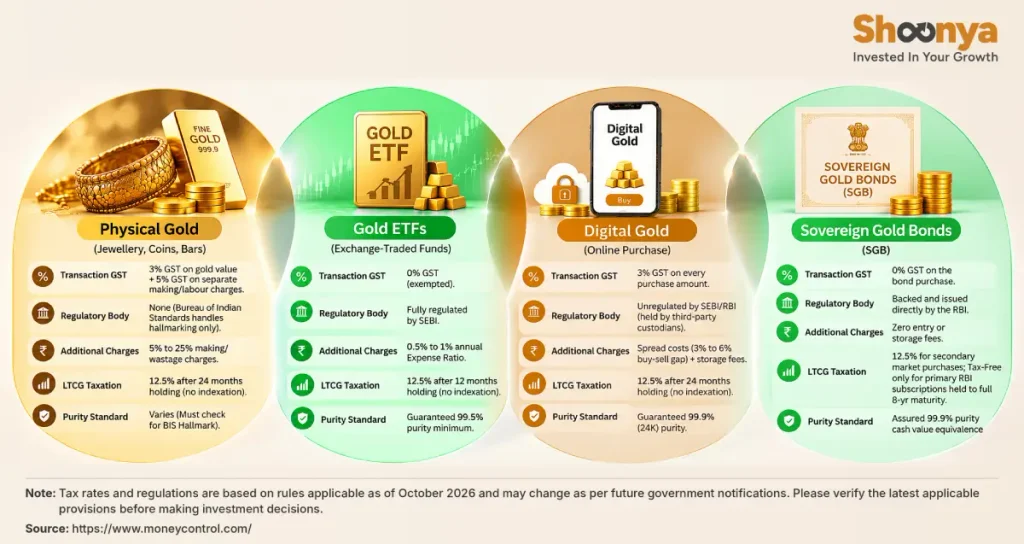
Gold ETFs vs Physical Gold vs Digital Gold: Key Differences
Gold ETFs provide exposure to gold prices through exchange-traded fund units, while physical gold gives you direct ownership of jewellery, coins or bars. Digital gold allows you to buy gold online, with a provider arranging storage on your behalf.
| Factor | Gold ETFs | Physical Gold | Digital Gold | Sovereign Gold Bonds (SGB) |
|---|---|---|---|---|
| Form | Digital asset units in a Demat account | Tangible jewellery, coins, or bars | Digital balance backed by physical vaults | RBI-issued government securities |
| Regulation | Regulated by SEBI | Regulated by BIS (Hallmarking) | Unregulated by SEBI or RBI | Regulated by RBI |
| Minimum Entry | 1 Unit (~0.01g to 0.1g worth, approx. ₹50–₹100) | Typically 1 gram for coins | From ₹1 onwards | 1 Gram |
| Transaction Costs | Annual Expense Ratio (0.5%–1%) | 5%–25% Making charges + GST | 3% GST + hidden spread costs | Zero making/storage costs |
| Storage Security | High (Held by NSDL/CDSL; physical gold held by SEBI Custodians) | Low (Prone to theft; requires bank locker fees) | Moderate (Stored by platform; time-bound limits) | High (Held digitally in Demat or RBI ledger) |
Dhanteras Gold Buying Options: How Do Taxation Rules Differ?
Gold investments are taxed differently depending on the type of gold and how long you hold it.
Here is how gold ETFs, gold mutual funds, digital and physical gold are taxed –
- Gold ETFs & Gold Mutual Funds: If you sell your units within 12 months, the profits are Short-Term Capital Gains (STCG) and are taxed at your regular income tax slab rate. If held for more than 12 months, they qualify as Long-Term Capital Gains (LTCG) and are taxed at a flat 12.5% without indexation benefits.
- Physical Gold & Digital Gold: The long-term horizon is longer. Holdings must be kept for more than 24 months to qualify for the 12.5% flat LTCG rate (no indexation). Anything sold under 24 months is added to your income slab.
- Sovereign Gold Bonds (SGBs): While the annual 2.5% interest payouts are taxed as per your income slab, the final capital gains realised at the 8-year maturity mark are 100% tax-free, making it highly lucrative for long-term investors.
Is it Better to Buy Physical Gold or a Gold ETF?
If you’re buying gold to wear or gift during festivals, physical gold is worth considering. But if your goal is investment for the long run, Gold ETFs can be a more convenient option. They come with no jewellery-making charges or storage hassles. However, fund expenses and market risks still apply.
- Cost Efficiency: Gold ETFs avoid jewellery-making charges but have fund expenses and trading costs. Physical gold may involve GST, making charges and resale deductions.
- Liquidity: Gold ETFs can be sold during market hours, depending on buyer availability. Physical gold resale depends on the jeweller’s buyback policy, purity and prevailing gold rates.
- Personal Use: Physical gold is suitable for wearing, gifting or traditional occasions, while Gold ETFs offer gold price exposure without physical possession.
If you want to invest in gold without worrying about purity or storage, Gold ETFs are a strong option. Start investing with Shoonya at zero AMC.
Gold ETF vs Physical Gold : FAQs
Is a Gold ETF a good investment?
A Gold ETF is a good option for investors who prefer a digital, transparent, and hassle-free way to invest. However, the choice ultimately depends on your financial goals
Can a Gold ETF Be Converted Into Physical Gold?
No, retail investors generally cannot directly convert Gold ETF units into physical gold. They can sell their units on the stock exchange and use the proceeds to purchase gold jewellery, coins or bars. Physical redemption directly from the Mutual Fund House (Asset Management Company) is strictly restricted to Authorised Participants (APs) and institutional investors who trade in massive wholesale lots.
Physical Gold vs Gold ETF: Which Is More Cost-Effective?
Physical gold jewellery may involve making charges, storage expenses and resale deductions. Gold ETFs avoid jewellery-making charges but involve fund expenses, trading costs and possible differences between market price and underlying value.
How to Convert Gold BeES to Physical Gold?
Retail investors generally cannot directly convert Gold BeES into physical gold. They can sell their ETF units on the NSE or BSE and use the proceeds to purchase gold coins, bars or jewellery. Direct physical redemption is subject to the fund’s eligibility criteria and minimum quantity requirements.
Are Gold ETFs taxed like Physical Gold?
Gold ETFs and physical gold are both subject to capital gains tax, but their holding periods differ. Listed Gold ETFs generally qualify for long-term treatment after 12 months, while physical gold generally requires more than 24 months. Applicable tax rules and rates should be checked before selling.


Explore Our Offerings

Stocks
Trade equities across NSE and BSE with zero delivery charges. Invest, hold or sell with a seamless experience.


Future & Options
Execute complex strategies with simple tools and real-time data.

IPOs
Apply to the latest IPOs in just a few taps. Stay updated and capture opportunities as they open.