




September 16, 2026

September 18, 2025
September 10, 2025
July 3, 2025
What Is Commodity Market: Types, Trading and Regulation

Author
Shoonya Team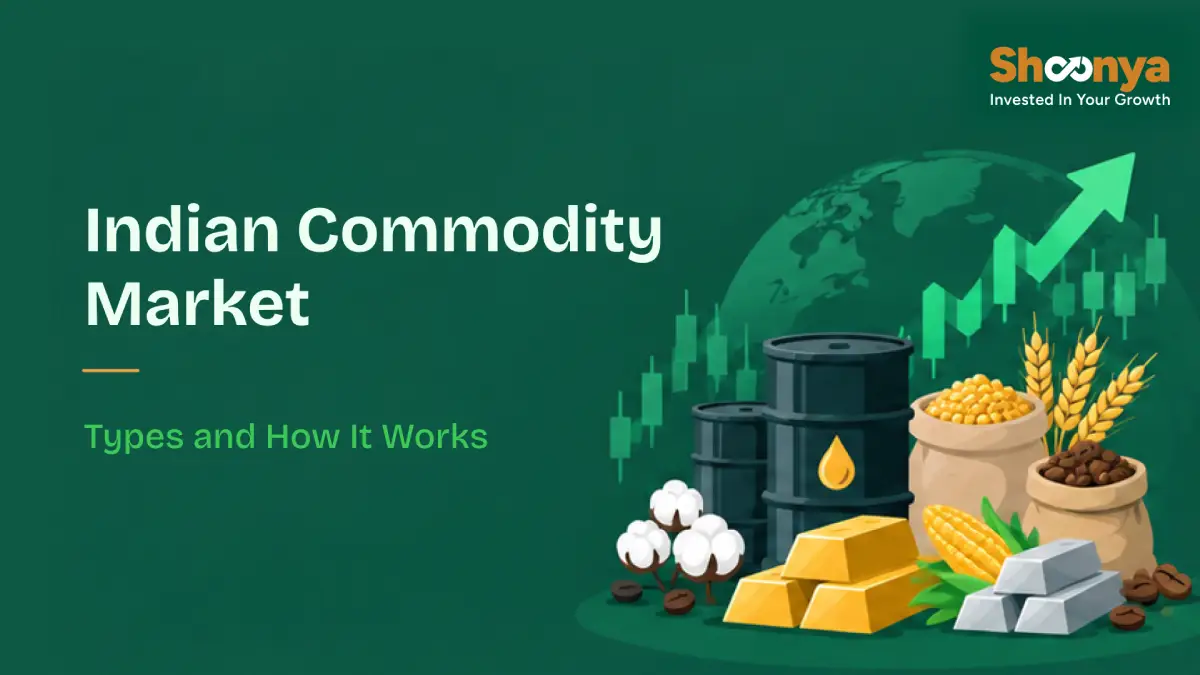
Every time crude oil prices spike, or gold rates climb, there’s an entire market working behind the scenes, one most people never actively trade in but interact with indirectly every single day. That’s the commodity market, where raw materials like gold, crude oil, natural gas, and farm produce are bought and sold, not as physical goods changing hands, but as standardised contracts on regulated exchanges.
This blog covers what the commodity market is, how it works, who trades in it, and what actually moves commodity prices.
What Is the Commodity Market?
A commodity market is a regulated marketplace where raw materials and primary goods, such as precious metals, crude oil, natural gas, and agricultural products, are traded through standardised contracts.
In India, this trading happens on exchanges like MCX (Multi Commodity Exchange) and NCDEX (National Commodity and Derivatives Exchange), both regulated by SEBI.
What Are the Types of Commodities Traded?
Commodities are typically grouped into two broad types:
- Hard commodities: Natural resources that are mined or extracted, such as gold, silver, crude oil, and natural gas
- Soft commodities: Agricultural products that are grown or farmed, such as cotton, wheat, coffee, and rubber
They can be further broken down by category:
- Bullion: Gold, silver
- Metals: Aluminium, copper, lead, nickel, zinc
- Energy: Crude oil, natural gas
- Agricultural commodities: Black pepper, cardamom, castor seed, cotton, crude palm oil, mentha oil, rubber
- Livestock: Live cattle and related products
Which Exchanges Regulate Commodity Trading in India?
SEBI regulates commodity trading in India and took over oversight after its merger with the Forward Markets Commission in 2015.
- MCX (Multi Commodity Exchange): India’s leading exchange for bullion, metals, and energy commodities
- NCDEX (National Commodity and Derivatives Exchange): Primarily focused on agricultural commodities
Earlier exchanges like NMCE and ICEX see limited or negligible trading activity today. SEBI has also periodically suspended futures and options trading in specific agricultural commodities, so check which contracts are currently active before trading.
How Does the Commodity Market Work?
The commodity market functions through two core methods: immediate delivery via the spot market, and future-dated contracts via the derivatives market, both regulated through centralised exchanges.
- Spot market: Buyers pay cash for immediate physical delivery of the raw good; the transaction settles right away
- Futures contracts: Standardised agreements to buy or sell a specific quantity of a commodity at a predetermined price on a future date
- Cash settlement: Most retail traders close their positions before expiry, settling gains or losses in cash rather than taking physical delivery
- Exchanges: Centralised platforms such as MCX and NCDEX in India facilitate and regulate these trades, ensuring standardisation and transparency
Key Market Participants
- Hedgers: Farmers, miners, or manufacturers who use futures contracts to lock in prices and protect against adverse market swings
- Speculators: Traders who take on price risk based on anticipated market movements, without any intention of taking physical delivery
- Arbitrageurs: Traders who look to capitalise on small price differences for the same commodity across different markets or exchanges
For example, if a trader buys a gold mini futures contract at ₹72,000 per 100 grams and the price rises to ₹73,000 the next day, a ₹1,000 gain gets credited to their account. If it falls to ₹72,500 instead, ₹500 gets deducted. This daily settlement continues until the contract expires or is closed out.
How Can You Trade Commodities?
You can trade commodities through two types of derivative contracts, each with a different level of obligation.
- Futures contracts: An agreement to buy or sell a specific quantity of a commodity at a predetermined price on a future date. These can be exchange-traded, overseen by exchanges like MCX or NCDEX, or over-the-counter, conducted without exchange oversight
- Options contracts: Give traders the right, but not the obligation, to buy or sell a commodity at a fixed price, involving a lower level of obligation than futures
Who Trades in the Commodity Market?
Commodity markets bring together two distinct types of participants, each trading for a different purpose.
- Speculators: Trade based on anticipated price movements, buying futures contracts when they expect prices to rise and selling when they expect prices to fall, aiming to profit from the difference
- Hedgers: Use futures contracts to offset price risk tied to a commodity they physically deal in. For example, a farmer can hedge against falling crop prices at harvest time by locking in a price through a futures contract in advance
What Determines Commodity Prices?
Commodity prices move based on four key factors.
- Demand and supply: Rising demand or tightening supply typically pushes prices up, while the reverse pulls them down
- Global events: International developments, such as geopolitical tension in oil-producing regions, can directly affect domestic commodity prices
- Production factors: Higher production costs or supply disruptions can push prices higher
- Speculative activity: Traders taking positions based on anticipated price movements can add to short-term volatility
How Are Commodity Markets Linked to the Stock Market?
Commodity and equity markets often move in different directions during periods of high inflation. As commodity prices rise, central banks may respond by raising interest rates to control inflation, which increases borrowing costs and tends to weigh on stock valuations.
Higher rates also make fixed-coupon bonds less attractive, pressuring bond prices. Commodities like precious metals, by contrast, are often viewed as a hedge during such periods, which is why commodity and equity markets can move inversely when inflation rises.
What Are the Advantages of Commodity Market?
Trading in commodities offers five key advantages for market participants.
- Portfolio diversification: Adding commodities to a portfolio can reduce dependence on traditional assets like stocks and bonds
- Risk management: Hedging through futures contracts helps producers and traders offset price volatility in the physical market
- Support for agriculture: Price discovery through commodity trading can encourage more efficient production and improve income prospects for farmers
- Price visibility: Futures pricing gives market participants a sense of expected price direction, helping with production, procurement, and pricing decisions
- Better market access: Commodity platforms can help farmers and producers sell more directly, reducing dependence on intermediaries, and some also offer financing linked to commodity holdings
What Are the Limitations of the Commodity Market?
Commodity market trading carries three notable risks that set it apart from equity trading.
- High leverage risk: Commodity trading often involves greater leverage than equities, which can amplify losses if the market moves against expectations
- High volatility: Commodities like crude oil and gold can see sharper price swings than stocks or bonds
- Sensitivity to external events: Prices react quickly to geopolitical developments, production changes, and global supply shifts, which can be difficult to anticipate
Till What Time Is the Commodity Market Open?
Commodity market timings in India are structured around two main sessions, with some variation by segment and time of year.
- Morning session: 9:00 AM to 5:00 PM
- Evening session: 5:00 PM to 11:30 PM (with Daylight Saving Time) or 11:55 PM (without DST)
- Agricultural commodities: Trade only during the 9:00 AM to 5:00 PM window
- Non-agricultural commodities (bullion, metals, energy): Trade through both sessions, closing at 11:30 PM or 11:55 PM depending on DST
- Pre-market session: A 14-minute window from 8:45 AM to 8:59 AM on MCX, during which traders can cancel pending orders before the session begins
- Muhurat Trading: A special one-hour session held on Diwali, typically between 6:00 PM and 7:15 PM, with exact timing varying by year
The commodity market operates Monday to Friday and stays closed on weekends.
Note: These timings can be revised by exchanges from time to time, so it’s worth confirming current hours on MCX or NCDEX before trading.
Key Takeaways
- A commodity market is where raw materials like gold, crude oil, and agricultural products trade through standardised contracts on regulated exchanges
- Commodity market trading happens mainly through futures and options contracts, settled daily via mark-to-market
- Prices are driven by demand-supply dynamics, global events, and speculative activity
- Commodities can offer diversification and hedging value but carry higher leverage and volatility risk than equities
Commodities Market in India : FAQs
What is meant by the commodity market?
A commodity market is where raw materials like precious metals, crude oil, natural gas, and agricultural products are traded through standardised contracts on regulated exchanges.
What are the types of commodities traded in India?
Commodities are grouped into bullion, metals, energy, agricultural commodities, and livestock, traded mainly on MCX and NCDEX.
How does the commodity market work?
Commodities trade through standardised futures and options contracts, with daily settlement based on mark-to-market pricing until the contract expires or is closed out.
Who regulates the commodity market in India?
SEBI regulates commodity trading in India, overseeing exchanges like MCX and NCDEX.
What are the benefits of trading in the commodity market?
A commodity market offers portfolio diversification, a way to hedge against price volatility, and price visibility that can support planning for producers and traders.


Explore Our Offerings

Stocks
Trade equities across NSE and BSE with zero delivery charges. Invest, hold or sell with a seamless experience.


Future & Options
Execute complex strategies with simple tools and real-time data.

IPOs
Apply to the latest IPOs in just a few taps. Stay updated and capture opportunities as they open.