


September 16, 2026

September 18, 2025
September 10, 2025
July 3, 2025
Difference Between Demat and Trading Account: Meaning and Features

Author
Shoonya Team
If you are planning to enter the stock market, you will come across two terms: demat account and trading account.
One helps you place buy and sell orders, while the other holds the securities you own electronically. In this blog, you will understand the difference between a demat account and a trading account.
What Is a Trading Account?
A trading account lets you place orders to buy and sell securities in the stock market. It acts as a link between you and the stock exchange through your registered stockbroker.
When you place an order, your trading account is used to execute the transaction at the exchange.
What Are the Features of a Trading Account?
A trading account provides access to the stock market and enables you to place and manage market orders.
- Buy and sell orders: Place orders for securities available through your broker.
- Market access: Connect to recognised stock exchanges through the broker.
- Order tracking: Check the status of placed, executed, cancelled or pending orders.
- Transaction history: Review previous transactions and order details.
- Linked accounts: Usually works with your bank account and demat account for funds and securities.
- Multiple segments: Depending on activation and eligibility, it may provide access to equity and other permitted market segments.
Invest in stocks, bonds, mutual funds, ETFs, and more, with a free demat account !
Why Is a Trading Account Important?
A trading account is important because it provides the interface through which you can place buy and sell orders in the securities market. Without it, you cannot directly execute stock market transactions through a broker.
It helps you:
- Place buy and sell orders through your broker.
- Track orders and transactions.
- Access different market segments, where enabled.
- Connect your bank and demat accounts with your stock-market transactions.
- Manage market activity from a single platform.
What Is a Demat Account?
A demat account is an account used to hold securities electronically instead of physical certificates. The term “demat” comes from dematerialisation, which refers to converting physical securities into electronic form.
In India, demat accounts are maintained with Depository Participants associated with depositories such as NSDL or CDSL.
What Are the Features of a Demat Account?
The main purpose of a demat account is to electronically hold securities owned by an investor. It also facilitates the electronic transfer of eligible securities.
Key features include:
- Electronic holding: Securities are stored in dematerialised form.
- Ownership records: Your eligible securities are reflected in your demat holdings.
- Electronic transfers: Securities can be credited or debited electronically.
- Corporate actions: Eligible benefits such as bonus shares and stock splits can be reflected in the account.
- Account statements: You can review your securities holdings and transactions.
- Multiple securities: Different eligible securities can be held in the same demat account.
Why Is a Demat Account Important?
A demat account provides an electronic way to hold and manage securities without relying on physical certificates. It also supports the electronic settlement and transfer of securities.
A demat account helps you:
- Hold eligible securities electronically.
- Keep a record of your securities holdings.
- Receive purchased securities after settlement.
- Transfer securities when required.
- Receive eligible corporate actions electronically.
- Avoid risks associated with handling physical share certificates.
Demat Account vs Trading Account: What Is the Difference?
The main difference between a demat and trading account is their function: a trading account is used to buy and sell securities, while a demat account is used to hold them.
| Basis | Demat Account | Trading Account |
|---|---|---|
| Purpose | Holds securities electronically | Used to place buy and sell orders |
| Main function | Storage and transfer of securities | Execution of market transactions |
| Operated through | Depository Participant | Stockbroker |
| Linked to | Depository system | Stock exchange through broker |
| Securities | Reflects eligible securities held by you | Facilitates transactions in permitted market segments |
| Balance | Shows securities holdings | Shows trading-related funds, orders and positions depending on the broker |
| Required for | Holding securities in demat form | Placing market orders |
| Role during purchase | Receives securities after settlement | Used to place the purchase order |
| Role during sale | Securities are debited as required for settlement | Used to place the sell order |
Explore Trading Account and Demat Account Charges and Fees in India.
How Do Demat and Trading Accounts Work Together?
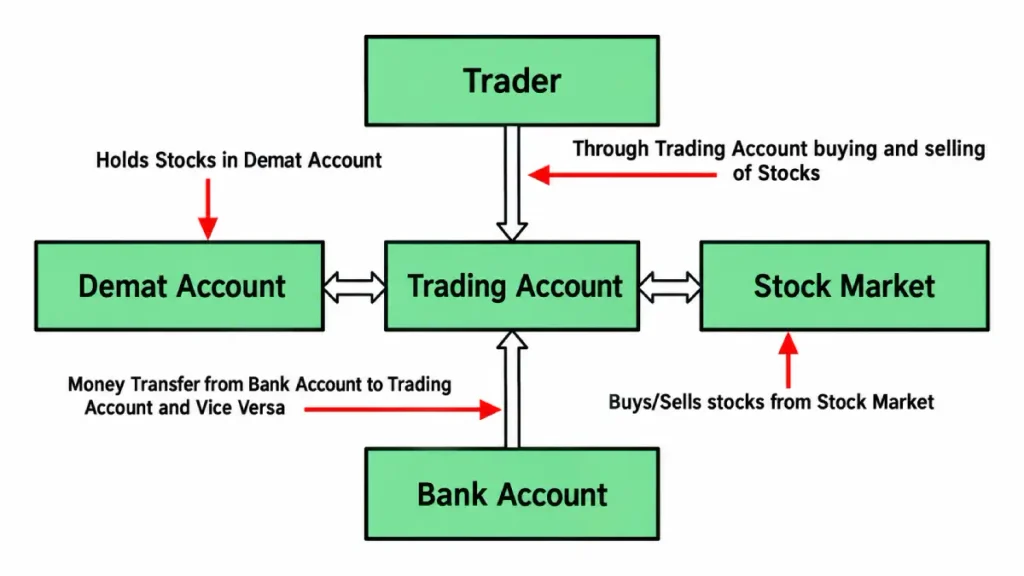
A demat and trading account perform different roles but can work together when you buy or sell securities. The trading account handles the order, while the demat account handles the electronic holding and movement of securities.
When you buy shares:
- Place a buy order through your trading account.
- The order is sent to the stock exchange through your broker.
- Once executed and settled, the purchased securities are credited to your demat account.
When you sell shares:
- Place a sell order through your trading account.
- The required securities are debited from your demat account as part of the settlement process.
- After settlement, the sale proceeds are handled through the applicable broker and banking process.
Can You Open a Demat and Trading Account Together?
Yes, many stockbrokers allow you to open a demat and trading account through a single onboarding process. The accounts remain functionally different even when they are opened and accessed through the same platform.
How to Open a Demat and Trading Account?
You can usually open a demat and trading account together through a registered stockbroker that also provides demat services through a Depository Participant. Both accounts can be opened through a single onboarding and KYC process.
- Choose a registered stockbroker and Depository Participant.
- Visit its official website or mobile app.
- Enter your PAN, mobile number and other required details.
- Complete the KYC and identity verification process.
- Add and verify your bank account.
- Select the market segments you want to activate, where applicable.
- Review and e-sign the required documents.
- Once verification is complete, your demat and trading accounts are activated.
Quick steps to open demat account on Shoonya!
Although the functions of a demat and a trading account are different, both can work together during securities transactions.
Demat vs Trading Account : FAQs
What is the difference between a demat account and trading account?
A demat account holds securities electronically, while a trading account is used to place buy and sell orders in the stock market.
Is a demat account the same as a trading account?
No. They serve different purposes. A demat account stores securities, whereas a trading account facilitates market transactions.
Can I have a demat account without a trading account?
Yes. A demat account can exist independently for holding securities. However, a trading account is generally required when you want to buy or sell securities through a stockbroker.
Do I need both a demat and trading account to buy shares?
For buying and holding shares through a broker, both accounts generally work together: the trading account is used to place the order, and the demat account receives the shares after settlement.
What is the demat account meaning?
A demat account is an electronic account used to hold securities in dematerialised form instead of physical certificates.
What is a trading account?
A trading account enables an investor to place buy and sell orders in the securities market through a registered stockbroker.
Which is better: demat or trading account?
They cannot be compared as better or worse because they perform different functions. A trading account facilitates transactions, while a demat account holds securities.
Can demat and trading accounts be with different providers?
Yes, they can be maintained with different eligible providers, although using linked accounts with the same broker/DP may make the transaction process more convenient.
Is a Trading Demo Account the Same as a Trading Account?
No. A trading demo account is generally a simulated environment used to understand a platform or practise placing virtual transactions. It does not function like a live trading account through which actual securities transactions are executed.


Explore Our Offerings

Stocks
Trade equities across NSE and BSE with zero delivery charges. Invest, hold or sell with a seamless experience.


Future & Options
Execute complex strategies with simple tools and real-time data.

IPOs
Apply to the latest IPOs in just a few taps. Stay updated and capture opportunities as they open.