



September 16, 2026

September 18, 2025
September 10, 2025
July 3, 2025
Hard and Soft Commodities: Differences and Examples

Author
Shoonya Team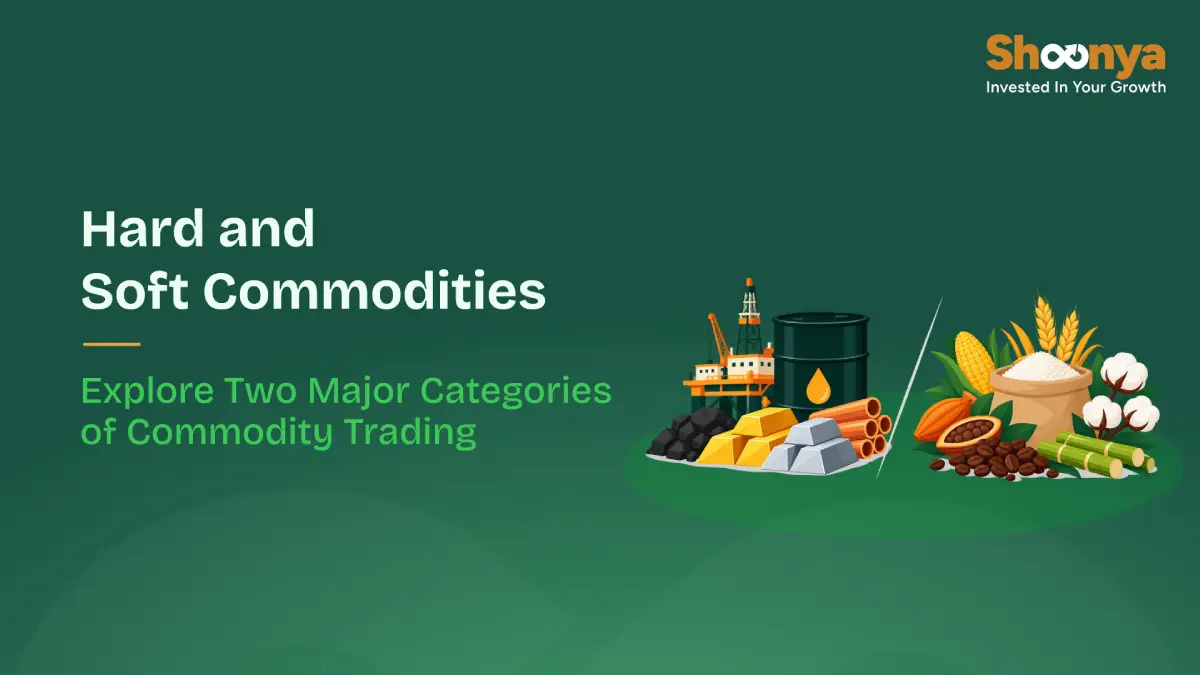
On the same day, gold prices rise amid global economic uncertainty, while wheat prices increase after unexpected rainfall damages crops in a major producing region. Both are commodities, yet their prices respond to different events. One may attract attention during financial uncertainty, while the other is closely linked to agricultural production.
But why do some commodities react strongly to weather conditions while others move with industrial demand and international developments?
The answer lies in the difference between hard and soft commodities. Their origins influence how they are produced, supplied, stored and traded.
Let us explore these categories.
What Are Hard Commodities?
Hard commodities are natural resources obtained through mining, drilling or extraction from the Earth. Hard commodities are generally grouped into precious metals, industrial metals and energy resources.
Their production often requires specialised equipment, substantial infrastructure and long-term investment.
Common examples of hard commodities are:
- Gold: Used in jewellery, investment and electronics.
- Silver: Used in solar panels, electrical equipment and jewellery.
- Copper: Used in electrical wiring, infrastructure and manufacturing.
- Crude oil: Refined into petrol, diesel and other petroleum products.
- Natural gas: Used in electricity generation, heating and industrial processes.
Their value is influenced by industrial activity, global economic conditions, extraction costs and international developments.
What Are Soft Commodities?
Soft commodities are agricultural goods that are grown, cultivated or raised rather than mined. They include crops, plantation produce and certain livestock products.
Their availability is closely connected to farming cycles, climate conditions and biological growth.
Common examples of soft commodities include:
- Wheat: Used in flour, bread and food processing.
- Cotton: A major raw material for clothing and textiles.
- Coffee: A plantation crop used in beverages.
- Sugar: Produced mainly from sugarcane and sugar beet.
- Soybeans: Used in edible oils, food products and animal feed.
For example, a drought affecting a major coffee-producing region may reduce expected harvest volumes and influence international prices.
What Is the Difference Between Hard and Soft Commodities?
Hard commodities are extracted natural resources, while soft commodities come from agriculture.
| Comparison | Hard Commodities | Soft Commodities |
|---|---|---|
| Examples | Gold, copper, crude oil | Wheat, cotton, coffee |
| Production | Mining, drilling and extraction | Farming, cultivation and harvesting |
| Supply | Depends on reserves and extraction capacity | Depends on crop cycles and harvest output |
| Price Drivers | Industrial demand, global events, production costs | Weather, crop yields, agricultural demand |
| Weather Impact | Usually indirect; may disrupt extraction | Often directly affects crop growth |
| Storage | Metals are durable; energy needs specialised facilities | Often requires moisture and pest control |
| Seasonality | Linked to industrial and energy demand patterns | Linked to planting and harvesting cycles |
| Major Risks | Geopolitical tensions, production disruptions | Droughts, floods, crop diseases |
| Main Buyers | Manufacturers, refiners, energy companies | Food processors, textile manufacturers |
1. How Do Production and Supply Cycles Differ?
Hard commodity production often requires significant infrastructure and long-term planning.
For example, developing a new copper mine may involve years of exploration, environmental assessments, approvals and construction.
Even when demand increases, mining companies may not be able to expand output immediately.
Agricultural production operates differently.
A wheat farmer generally decides how much land to cultivate before knowing the final harvest quantity or selling price.
Once the growing season begins, opportunities to increase output may be limited until the next planting cycle.
2. What Factors Influence Their Market Prices?
Both categories follow supply and demand, but the underlying influences can differ.
- Changes in industrial production
- Global economic growth
- Mining output and energy production
- Geopolitical tensions
- Currency movements and interest rates
- Rainfall and temperature
- Crop diseases and pest outbreaks
- Harvest forecasts
- Agricultural trade restrictions
- Food consumption and processing demand
For example, increasing investment in electrical infrastructure may support copper demand because it is widely used in power networks and electrical equipment.
3. How Do Storage and Shelf Life Compare?
Many metals can be held for extended periods without significant deterioration when stored appropriately. However, energy products require specialised arrangements. Crude oil needs storage tanks, while natural gas requires suitable pipelines or storage infrastructure.
Agricultural goods face different challenges. Excessive moisture, insects and improper storage conditions can reduce the quality of grains and other farm products.
For example, poorly stored wheat may lose commercial value due to moisture damage or contamination.
Storage expenses, handling requirements and product quality can therefore influence market supply and trading costs.
4. How Do Seasonality and Global Events Affect Each Category?
Soft commodities often see recurring supply changes because of agricultural seasons.
Crop arrivals may increase after harvesting, while production forecasts can change with rainfall and growing conditions.
Hard commodities are not directly tied to planting or harvesting seasons, but demand can still vary throughout the year.
For example, natural gas consumption may increase during colder months in countries where it is widely used for heating.
International developments can affect either category. A major mining disruption may restrict metal production, while agricultural export restrictions may influence food supplies in importing countries.
5. What Are the Different Trading Risks?
Both hard and soft commodities involve price-related uncertainties.
Hard commodities can face disruptions from mining shutdowns, geopolitical developments, energy production decisions, and changes in industrial activity.
Soft commodities may face unexpected supply shortages after severe weather, pest outbreaks, or crop diseases.
However, neither category is automatically more volatile than the other.
How Are Hard and Soft Commodities Traded in India?
In India, commodities are bought and sold in physical markets, while eligible products can also be traded through exchange-listed derivatives.
Physical Commodity Trading
Physical markets involve the exchange of actual goods between producers, suppliers, manufacturers and buyers.
For example, a textile business may purchase raw cotton for manufacturing, while a construction company may obtain metal supplies for its projects.
Such transactions involve quality checks, delivery arrangements, transportation and payment terms.
Commodity Futures and Options
Commodity derivatives are contracts whose value depends on an underlying commodity.
Two common instruments are:
- Futures: Standardised contracts involving obligations related to an underlying commodity at a specified future date.
- Options: Contracts that provide defined rights to buyers and corresponding obligations to sellers, depending on the contract terms.
These instruments may be used to manage price exposure or participate in commodity market movements.
For example, a manufacturer concerned about future input costs may use a suitable derivatives contract to manage some of that exposure.
However, hedging involves costs and limitations and does not eliminate every market or business risk.
Which Exchanges Offer Commodity Trading?
The Multi Commodity Exchange of India (MCX) provides trading facilities for various eligible commodity derivatives.
According to MCX’s published market schedule:
- Internationally referenced non-agricultural commodities generally trade from 9:00 AM to 11:30 PM or 11:55 PM, depending on daylight-saving adjustments.
- Internationally referenced agricultural commodities may trade until 9:00 PM.
- Other agricultural commodities generally trade until 5:00 PM.
What Should Traders Understand Before Participating in Commodity Markets?
Participating in commodity derivatives also involves understanding contractual and financial obligations.
- Contract Specifications: Futures contracts specify trading units, expiry dates, price quotations and settlement conditions. These details determine the nature of a position.
- Margin: Futures traders generally deposit margin rather than the full contract value. Adverse price movements may require additional funds.
- Market Liquidity: Trading volumes vary across commodities and contract months. Limited liquidity can make entering or exiting positions more difficult.
- Settlement Conditions: Some commodity contracts involve physical delivery provisions. Participants should understand the applicable settlement process and broker policies.
- Trading Costs: Brokerage, exchange transaction charges, applicable taxes and other statutory levies affect the overall cost of participation.
Final Thoughts
Hard and soft commodities support different parts of economic activity, from infrastructure and energy production to agriculture and consumer industries. Their supply conditions and market drivers influence how businesses source materials, manage production costs and respond to price changes.
Hard and Soft Commodities : FAQs
1. What is the difference between hard and soft commodities?
Hard commodities are natural resources obtained through mining or extraction, while soft commodities originate from agriculture or livestock production. Their supply conditions and production cycles influence their market behaviour.
2. What are five examples of hard commodities?
Gold, silver, copper, crude oil and natural gas are examples of hard commodities.
3. What are some common soft commodities?
Wheat, cotton, coffee, sugar and soybeans are common agricultural commodities. Their availability can be influenced by weather conditions, harvest output and agricultural demand.
4. Is gold a hard or soft commodity?
Gold is classified as a hard commodity because it is obtained through mining. Its price can respond to investment demand, interest rates, currency movements and global economic uncertainty.


Explore Our Offerings

Stocks
Trade equities across NSE and BSE with zero delivery charges. Invest, hold or sell with a seamless experience.


Future & Options
Execute complex strategies with simple tools and real-time data.

IPOs
Apply to the latest IPOs in just a few taps. Stay updated and capture opportunities as they open.