



September 16, 2026

September 18, 2025
September 10, 2025
July 3, 2025
Product vs Commodity: Meaning, Differences and Real Examples

Author
Shoonya Team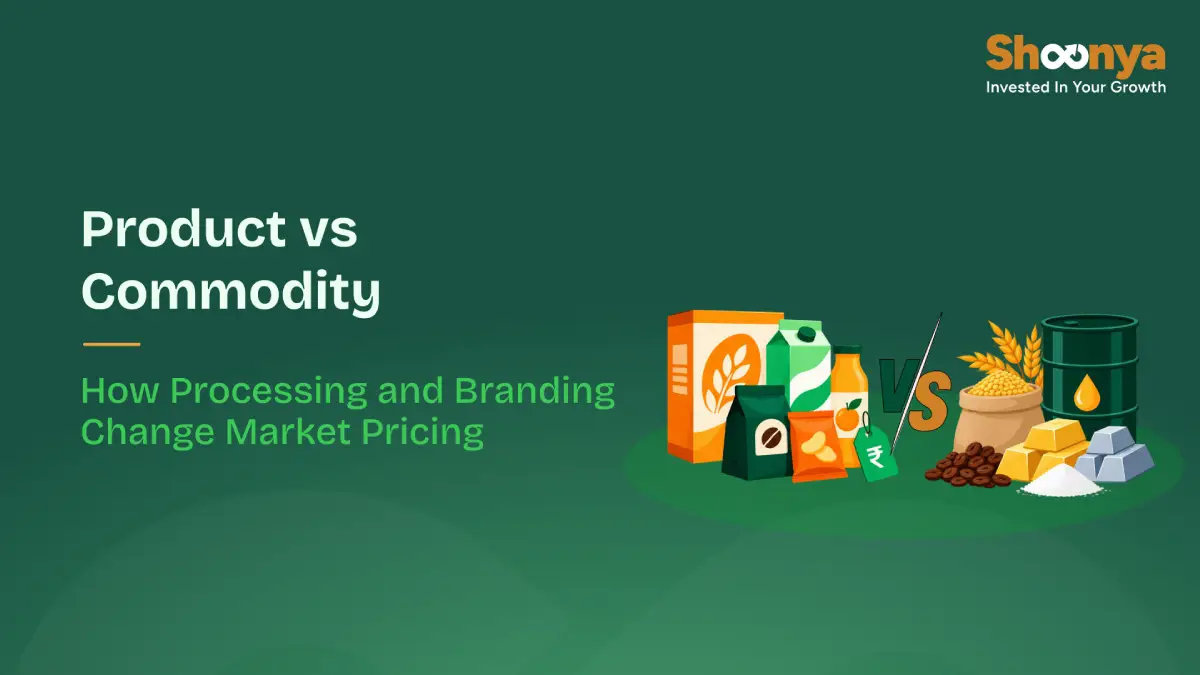
Think about buying a cup of coffee at a café. You might pay ₹200 for it, while the coffee beans used to prepare it cost only a fraction of that amount. Both come from the same source, yet their market prices and selling methods differ.
Why does this happen? Is it simply because one is ready to consume, or is there more to how businesses price and sell them?
This brings us to product vs commodity, a distinction that explains how materials and finished goods differ in value, characteristics and market demand.
What Is a Product?
A product is a good or service created or offered to meet a particular customer need.
In manufacturing and consumer markets, products are often finished goods ready for personal or commercial use.
Products have distinct characteristics that allow buyers to distinguish between competing alternatives.
For example, two smartphones may perform similar functions but differ in camera quality, storage capacity, design and software features.
These differences can influence consumer preferences and the prices businesses charge.
What Are the Main Types of Consumer Products?
Physical consumer products are commonly grouped by how long they last and how often they are used.
- Durable products: Items such as refrigerators, furniture, washing machines and vehicles that are typically used over an extended period.
- Non-durable products: Items such as packaged foods, beverages, soap and other everyday consumables that are used up relatively quickly.
Note: Products may also include services and digital offerings, although this comparison focuses mainly on physical goods.
What Is a Commodity?
A commodity is a basic good or material that can be bought and sold and is generally interchangeable with other units meeting the same specifications or quality grade.
Commodities are commonly used in agriculture, manufacturing, construction and energy production.
For example, copper of a specified grade can be used by different manufacturers without necessarily depending on the identity of the mining company that supplied it.
Commodity goods are commonly classified into two broad categories:
| Type | Meaning | Examples |
|---|---|---|
| Hard commodities | Natural resources generally extracted or mined | Gold, silver, copper, crude oil, natural gas |
| Soft commodities | Primarily agricultural goods | Cotton, wheat, sugar, coffee |
What Is the Difference Between Product and Commodity?
Commodities are generally traded according to common specifications, while products may offer distinctive features, functionality, packaging or services.
| Basis | Product | Commodity |
|---|---|---|
| Nature | May be finished, semi-finished, physical or intangible | Usually physical, raw or minimally processed |
| Standardisation | Specifications may differ among sellers | Often follows recognised grades and quality standards |
| Differentiation | Can vary in design, features and functionality | Units of the same grade are generally interchangeable |
| Branding | Can strongly influence customer perception | Usually less dependent on individual producer branding |
| Pricing | Influenced by production costs, features, competition and customer demand | Influenced largely by supply, demand, quality and market conditions |
| Value addition | May involve manufacturing, design, packaging and services | Often involves limited processing to meet market standards |
| Buyers | Consumers, businesses and institutions | Producers, processors, manufacturers and traders |
| Competition | Businesses may compete through product characteristics and customer experience | Sellers often compete through price, grade, availability and delivery |
| Examples | Branded clothing, furniture, smartphones and packaged foods | Cotton, timber, copper, wheat and crude oil |
The following factors explain how these differences influence actual buying and selling decisions.
1. How Do Standardisation and Differentiation Compare?
Standardisation refers to producing or classifying goods according to common specifications.
Commodities generally rely on recognised standards because buyers need confidence in the quantity and quality they are purchasing.
For instance, a buyer purchasing a specified grade of copper expects it to meet defined purity requirements, regardless of the supplier.
Products allow more scope for differentiation.
Consider two refrigerators with similar storage capacities. One may offer additional cooling controls, energy-efficient technology or a longer warranty. Customers may consider these characteristics when choosing between competing models.
2. What Determines Product and Commodity Prices?
Both markets respond to demand and supply, but their pricing differs.
Commodity prices are influenced by broader market conditions, including:
- Production and available inventory
- Industrial or consumer demand
- Weather and seasonal conditions
- Geopolitical developments
- Transportation and storage costs
- Currency movements
Businesses selling differentiated goods may consider several additional factors:
- Manufacturing and operating expenses
- Product design and functionality
- Distribution and retailer margins
- Competitive positioning
- Customer preferences
- After-sales support and warranty costs
For example, poor weather in a major wheat-producing region may reduce expected output and influence market prices. A single producer generally has limited control over the wider market price of a widely traded commodity.
For example, two pairs of running shoes may contain similar materials but sell at different prices because of differences in construction, comfort, durability and brand positioning. The final selling price reflects more than the cost of the materials used.
3. How Do Demand and Competition Affect Each?
Demand for commodities is frequently influenced by the industries that consume them.
Copper demand, for example, may increase with electrical infrastructure development, construction activity and industrial manufacturing.
This is an example of derived demand, where the need for a raw material depends partly on demand for the goods produced from it.
Finished consumer goods face another layer of competition.
Customers can compare alternatives based on convenience, quality, personal preference and available features.
A business may therefore gain market share by improving its offering, even when overall demand in the category remains relatively stable.
Commodity suppliers, meanwhile, may face stronger competition based on price and availability when their goods meet the same technical requirements.
4. What Role Do Quality and Branding Play?
In commodity markets, quality is often measured against technical or physical standards.
For example, agricultural produce may be assessed based on moisture content, impurities and other grading requirements.
A manufacturer purchasing these materials needs assurance that they satisfy production specifications.
In consumer markets, quality can also include usability, convenience, product life and customer experience.
Branding may help buyers identify a particular manufacturer and develop expectations based on previous experiences.
However, a recognised brand does not automatically guarantee superior performance.
Similarly, commodities are not completely free from branding or supplier reputation. Certification, origin and supply reliability can still affect purchasing decisions.
5. How Does Value Addition Influence Profitability?
Value addition refers to the activities that increase a good’s usefulness, convenience or perceived value.
These activities may include processing, assembly, research, design, packaging and distribution.
Suppose a furniture manufacturer purchases timber.
- The business must convert that material into a functional product through cutting, shaping, assembly and finishing.
- The selling price of the finished furniture must account for several costs beyond timber./li>
- These may include machinery, labour, transportation, storage, marketing and retailer margins./li>
- A higher selling price therefore does not necessarily mean a higher profit. /li>
- Profitability depends on how much revenue remains after the business covers its expenses.
What Is the Difference Between Goods and Commodities?
Goods are tangible items that can be bought, sold or used, while commodities are a particular category of goods generally traded according to common specifications.
The term goods is broader and can include raw materials, intermediate inputs and finished articles.
For example, a washing machine is a good, but it is not normally classified as a commodity in the same way as copper or crude oil.
Wheat, on the other hand, can be described as both a good and a commodity.
The terms may overlap because commodities themselves are physical goods.
How Are Products and Commodities Relevant to Financial Markets?
Commodity markets allow eligible participants to buy, sell or manage exposure to underlying physical goods.
In India, recognised exchanges such as the Multi Commodity Exchange (MCX) offer futures and options contracts on specified commodities.
These instruments may serve different purposes.
For example, businesses exposed to changes in raw material prices may use suitable derivatives to manage certain price risks, while other participants take positions based on their market expectations.
A futures contract is a standardised agreement governed by defined terms, including quantity, expiry and settlement conditions.
Commodity derivative trading involves risks, including leverage, price fluctuations and potential losses.
How Do Commodity Costs Affect Product Companies?
Changes in input prices can affect businesses that use those materials.
Example: Consider a company manufacturing electrical cables. Copper is a significant production input for many cable products. If copper prices increase, the company’s manufacturing costs may rise.
The impact on profitability depends on whether the business can adjust selling prices, manage procurement costs or improve operating efficiency.
Consequently, investors analysing manufacturing businesses may monitor both company financial results and the commodity markets linked to their operations.
What Is a Financial Product?
In financial markets, the word product can also refer to an investment or trading instrument rather than a manufactured consumer good.
Examples include:
- Equity shares
- Bonds
- Mutual funds
- Exchange-traded funds
- Futures and options contracts
A financial product has its own structure, investment purpose and associated risks.
End Note
Commodities form the foundation of many industries, while products reflect the additional value created through processing, innovation, functionality and customer experience.
With Shoonya, you can explore supported commodity trading instruments and other available financial market segments.
Open a demat account and start investing!
Open Your Demat Account →Product vs.Commodity : FAQs
1. What is the main difference between a product and a commodity?
A commodity is interchangeable with other goods meeting the same grade or specification. A product may have distinct features, functions or services that influence how customers compare and value it.
2. Can a commodity also be considered a product?
Yes, a commodity can be considered a product because it is something offered for sale.
3. What are some examples of commodity goods?
Examples of commodity goods include wheat, cotton, copper, crude oil, natural gas, gold and silver.
4. Is gold a product or a commodity?
Gold is commonly classified as a precious metal commodity. When it is converted into jewellery, the finished item may also be marketed as a differentiated consumer product based on its design, craftsmanship and other characteristics.
5. Why do branded products often cost more than commodities?
Product selling prices may reflect additional design, manufacturing, packaging, distribution, marketing and service expenses. However, branding alone does not guarantee a higher price or superior quality.


Explore Our Offerings

Stocks
Trade equities across NSE and BSE with zero delivery charges. Invest, hold or sell with a seamless experience.


Future & Options
Execute complex strategies with simple tools and real-time data.

IPOs
Apply to the latest IPOs in just a few taps. Stay updated and capture opportunities as they open.