




September 16, 2026

September 18, 2025
September 10, 2025
July 3, 2025
India’s ₹54 Lakh Crore Bond Market Push: Tokenisation and What’s Next

Author
Shoonya Team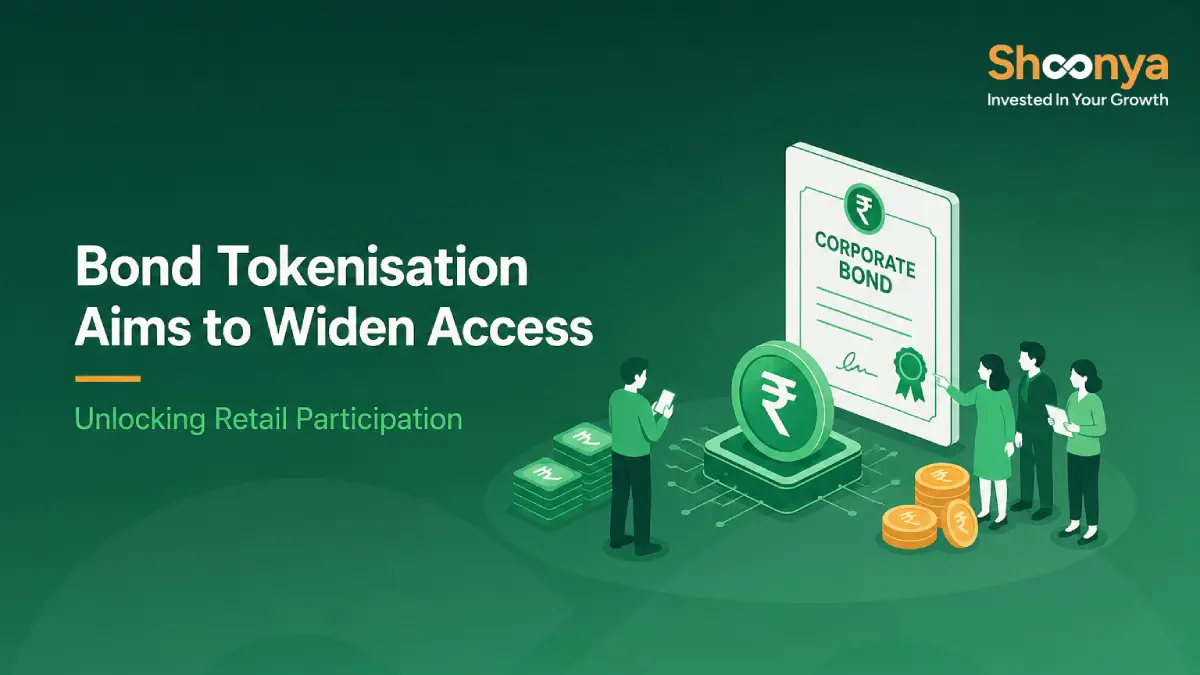
BSE Managing Director and CEO Sundararaman Ramamurthy said tokenisation can help widen retail access to India’s corporate bond market at the Bond Tokenisation Summit 2026. He said the market has grown sharply over the past decade but remains small relative to the economy and heavily concentrated in private placements and higher-rated issuers.
How Big Is India’s Corporate Bond Market Today?
India’s corporate bond market has moved from about ₹18 lakh crore to ₹54 lakh crore in a decade, but Ramamurthy said the current base still leaves room for expansion. The comparison with the US shows the gap clearly.
| Market Indicator | India | US |
|---|---|---|
| Corporate bond market as share of GDP | Around 10% | Around 40% |
| AAA-rated bonds as share of issuances | Part of 95-96% AAA and AA concentration | Around 5% |
| AA and BBB-rated bonds as share of issuances | Remainder of high-grade concentration | Around 60% |
Ramamurthy said India needs to address the narrow issuer profile so that more developing corporates can access the debt market.
Why Private Placement Dominance Is a Problem
Around 98% of corporate bond issuances in India currently happen through private placement. The BSE CEO said the high cost of public bond issuance is one reason companies prefer this channel.
That matters because public issuances give retail investors broader access. Ramamurthy said the market needs to reduce issuance costs so public placement becomes more common, and smaller investors can participate directly.
How Rating Concentration Limits the Market’s Reach?
Around 95 to 96% of Indian corporate bond issuances fall in the AAA and AA rating categories. This leaves developing corporates with limited access to the debt market and concentrates bond supply among a narrow set of large, highly rated issuers.
By comparison, AAA-rated bonds account for only around 5% of US issuances, while AA and BBB-rated bonds together make up around 60%.
What Tokenisation Could Change for Bond Investors
Ramamurthy said tokenisation can potentially make bond investments possible in smaller amounts, creating a new fixed-income avenue for retail participants. He said corporate bonds can offer retail investors measured risk alongside meaningful returns.
Beyond access, he outlined several other potential benefits:
- Fewer intermediaries in bond transactions
- Lower cost of capital for issuers
- Wider distribution of corporate lending risk
- New product possibilities for insurance and retirement savings
- Improved credit quality in bank lending
Faster Settlement Through Digital Infrastructure
Ramamurthy linked tokenised bonds to India’s digital payments infrastructure and the central bank digital currency. He said these systems could make transactions faster and more secure, with the potential to move from the existing T+1 settlement cycle to near-instantaneous processing.
Final Outlook
Ramamurthy’s remarks placed bond tokenisation at the centre of a larger market-access challenge. India’s corporate bond market has grown to ₹54 lakh crore, but retail reach, public issuance depth, and issuer diversity remain limited. Whether tokenised structures can lower entry sizes, reduce issuance friction, and fit within the regulatory framework for public debt markets will determine how much of that potential converts into actual change.
Source: Zee Business


Explore Our Offerings

Stocks
Trade equities across NSE and BSE with zero delivery charges. Invest, hold or sell with a seamless experience.


Future & Options
Execute complex strategies with simple tools and real-time data.

IPOs
Apply to the latest IPOs in just a few taps. Stay updated and capture opportunities as they open.