


September 16, 2026

September 18, 2025
September 10, 2025
July 3, 2025
What is the Difference Between Dematerialisation and Rematerialisation

Author
Shoonya Team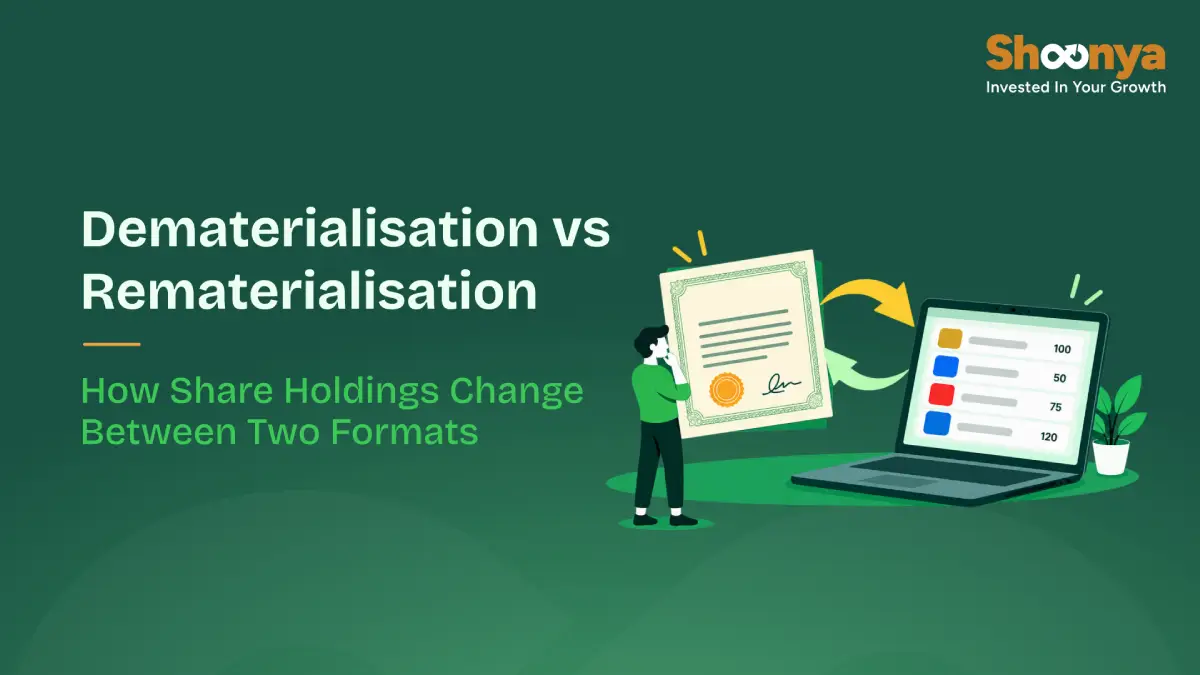
Imagine finding old share certificates a family member bought years ago. You want to sell those shares, but your broker requires them to be held electronically. This is where dematerialisation becomes necessary.
But what if you already hold shares digitally and want physical certificates instead? In that case, rematerialisation converts electronic securities back into physical certificates.
Let us understand their meaning, procedures, and key differences.
What Is Dematerialisation?
Dematerialisation converts physical share certificates into electronic securities held in a Demat account.
Instead of maintaining paper certificates, investors can hold eligible shares, bonds, and other securities electronically through a Depository Participant (DP), such as a registered stockbroker or bank.
In India, two depositories facilitate electronic securities holding:
- NSDL: National Securities Depository Limited
- CDSL: Central Depository Services (India) Limited
How Does Dematerialisation Work?
An investor holding physical certificates can request their conversion through the following process:
- Open a Demat account: Ensure that the account holder’s details match the records on the share certificates.
- Complete the request form: Fill out the Dematerialisation Request Form (DRF).
- Submit physical certificates: Provide the original certificates and completed DRF to the DP, following the required certificate-marking procedure.
- Verification: The DP processes the request and forwards the necessary documents to the issuing company or its Registrar and Transfer Agent (RTA).
- Receive electronic holdings: Once the issuer or RTA approves the request, the corresponding securities are credited to the Demat account.
What Is Rematerialisation?
Rematerialisation, commonly called remat, converts securities held in a Demat account back into physical certificates.
For example, an investor holding 200 shares electronically may request physical certificates for 100 of those shares, subject to the applicable requirements.
Rematerialisation changes the form in which ownership is recorded. It does not represent a sale or purchase of shares.
How Does Rematerialisation Work?
The rematerialisation process involves the investor, DP, depository, and issuer or RTA.
- Submit a request: Complete the Rematerialisation Request Form (RRF) and submit it to the DP.
- Account verification: The DP checks the request and verifies the availability of eligible securities.
- Block the holdings: The requested quantity is blocked in the Demat account while the application is processed.
- Issuer confirmation: The issuer or RTA verifies the request and arranges the physical certificates.
- Certificate delivery: The certificates are dispatched to the investor, and the corresponding electronic balance is debited following confirmation.
What Is the Difference Between Dematerialisation and Rematerialisation?
Dematerialisation makes eligible securities available for electronic transactions, whereas rematerialisation moves them out of electronic holding into certificate form.
| Basis | Dematerialisation | Rematerialisation |
|---|---|---|
| Meaning | Converts physical securities into electronic form | Converts electronic securities into physical certificates |
| Direction | Physical to electronic | Electronic to physical |
| Purpose | Enables electronic holding and transfer | Restores certificate-based holding |
| Starting requirement | Eligible physical share certificates | Eligible securities available in a Demat account |
| Request form | Dematerialisation Request Form (DRF) | Rematerialisation Request Form (RRF) |
| Final holding format | Securities credited electronically | Physical certificates issued |
| Record-keeping | Holdings maintained through the depository system | Certificate ownership recorded with the issuer/RTA |
| Trading | Supports electronic exchange transactions | Physical certificates must generally be dematerialised before exchange trading |
| Certificate risk | Eliminates the need to safeguard paper certificates | Requires protection against loss, theft, or damage |
| Applicable charges | DP processing charges may apply | Remat processing and certificate-related charges may apply |
What Is the Role of a Dematerialised Account?
A Demat account holds securities, whereas a trading account is used to place market orders. Although these accounts are often linked, they serve different functions.
- Holding records: View securities and quantities in one account.
- Electronic settlement: Receive and deliver securities through the depository system.
- Corporate actions: Eligible bonus shares and other securities benefits can be credited electronically.
- Account statements: Monitor holdings and transactions without maintaining physical certificates.
What Should Investors Check Before Converting Shares?
Before submitting either request, investors should understand the applicable requirements and limitations.
1. Ownership details
For dematerialisation, the names and holding pattern generally need to match the Demat account records. Mismatches may require additional formalities.
2. Security eligibility
Not every physical certificate can be converted automatically. The issuer and relevant security must be admitted to the depository system.
3. Processing charges
Dematerialisation (Demat) and rematerialisation (Remat) processing charges typically range from ₹150 to ₹500 per certificate or request, plus GST (18%) and courier charges (around ₹100).
4. Processing time
The dematerialisation or rematerialisation process is completed within 30 days.
5. Trading restrictions
Physical share transfers for listed securities have generally been restricted in India since April 1, 2019. Investors who wish to sell listed shares through stock exchanges normally need to hold them in Demat form.
Final Thoughts
The choice between dematerialisation and rematerialisation depends on how an investor needs to hold securities. Electronic holdings provide easier access to exchange transactions, while physical certificates require additional handling and may involve regulatory limitations.
For investors looking to hold and manage eligible securities electronically, Shoonya offers the option to open a Demat account and access its investment platform.
Ready to open your Demat account?
Open Your Shoonya Account →Dematerialisation vs Rematerialisation : FAQs
What does remat mean in the stock market?
Remat refers to converting securities held electronically into physical certificates through a Depository Participant.
Is dematerialisation compulsory for trading shares in India?
Listed shares traded on Indian stock exchanges need to be held and settled electronically. Investors may still possess older physical certificates, but restrictions apply to their transfer and trading.
How long does rematerialisation take?
According to NSDL, the rematerialisation process is completed within 30 days. Actual processing depends on proper documentation and completion of the required checks.
Does rematerialisation close a Demat account?
No, converting securities into physical certificates does not automatically close the account. Account closure requires a separate request and compliance with the DP’s conditions.
Does the number of shares change after dematerialisation?
No, the equivalent quantity of securities is credited electronically. However, any applicable corporate action or change in the security’s terms may affect the quantity.


Explore Our Offerings

Stocks
Trade equities across NSE and BSE with zero delivery charges. Invest, hold or sell with a seamless experience.


Future & Options
Execute complex strategies with simple tools and real-time data.

IPOs
Apply to the latest IPOs in just a few taps. Stay updated and capture opportunities as they open.