


September 16, 2026

September 18, 2025
September 10, 2025
July 3, 2025
Gold and Silver Investment on Dhanteras 2026: 5 Options to Know

Author
Shoonya Team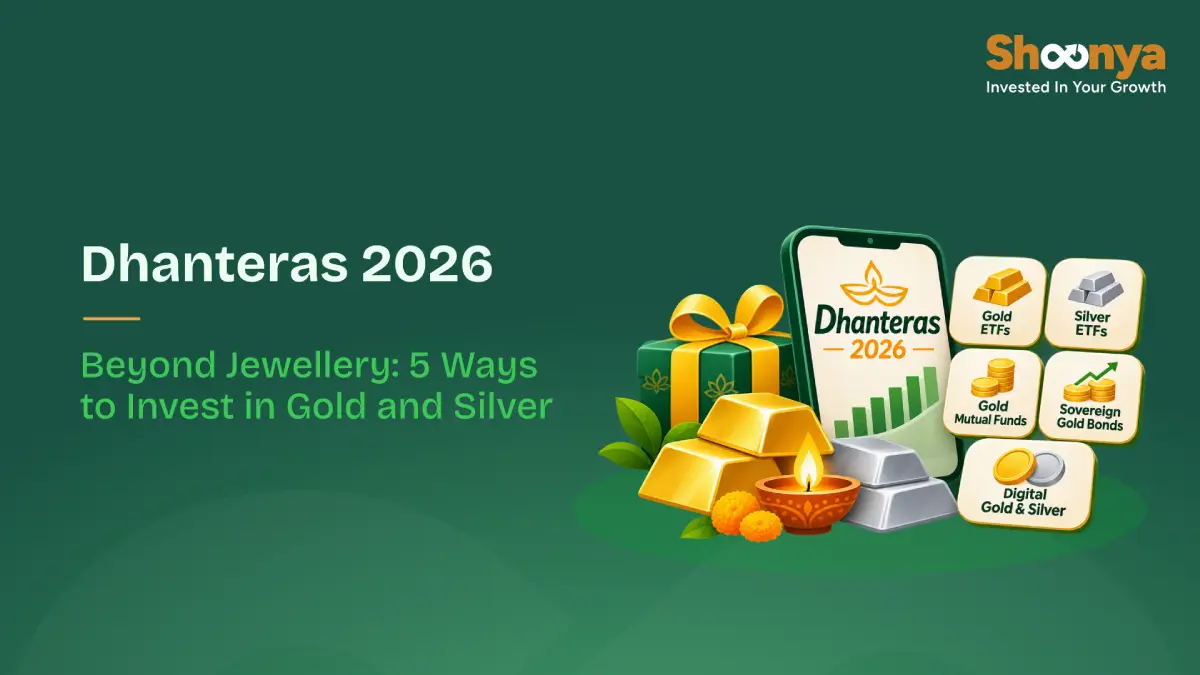
Dhanteras 2026 is being celebrated today, marking the beginning of the five-day Diwali festivities. Buying gold and silver has long been part of the occasion, with jewellery, coins and idols remaining traditional purchases.
However, precious metals are now available in several other formats, including exchange-traded funds, mutual funds and digital products. These gold and silver investment options differ in their costs, ownership structure, liquidity and regulatory oversight.
Here’s a look at five categories, their features and the differences between them.
What Are the Gold and Silver Investment Options for Dhanteras 2026?
For Dhanteras 2026, the five gold and silver investment options include Gold ETFs, Silver ETFs, Gold Mutual Funds, digital gold and silver, and physical coins and bars.
1. Gold ETF Investment
A Gold ETF investment allows investors to participate in gold price movements without purchasing physical gold themselves.
Gold ETFs are SEBI-regulated mutual fund schemes listed on exchanges such as NSE and BSE. They primarily invest in physical gold and permitted gold-related instruments.
Here are the key features of Gold ETFs:
- Gold purity: Physical gold held by these schemes generally meets the 995 fineness standard, equivalent to 99.5% purity.
- Trading: ETF units can be bought and sold during exchange trading hours through a demat and trading account.
- Minimum quantity: Exchange transactions generally begin with 1 ETF unit. Its rupee value depends on the scheme’s market price.
- Costs: Expense ratios, brokerage and other applicable transaction charges may apply.
- Returns: Performance reflects gold price movements, adjusted for fund expenses, tracking differences and market pricing.
For example, if an ETF unit trades at ₹100, purchasing 10 units would have a transaction value of ₹1,000 before applicable charges. This is an illustrative calculation, not a current ETF quotation.
2. Silver ETF Investment
A Silver ETF investment provides exposure to silver prices through units traded on stock exchanges.
Silver ETFs primarily invest in physical silver and permitted silver-related instruments. Their objective is to track domestic silver prices, subject to expenses and tracking differences.
Here are the key features of Silver ETFs:
- Silver purity: Physical silver held by these schemes generally meets the 999 fineness standard, equivalent to 99.9% purity.
- Trading: Units are bought and sold on stock exchanges through a demat and trading account.
- Price factors: Industrial demand, including electronics and solar applications, global supply, investment demand and currency movements influence silver prices.
- Costs: Fund expenses and applicable transaction charges affect overall returns.
- Liquidity: Trading volumes and bid-ask spreads can differ between ETF schemes.
Silver is used both as a precious metal and an industrial commodity. This makes its price movements sensitive to developments in manufacturing and global economic activity.
3. Gold Mutual Funds
Gold mutual funds provide exposure to gold through mutual fund schemes. A common structure in India is the Gold Fund of Funds (FoF), which invests in units of an underlying Gold ETF.
Unlike exchange-traded ETFs, Gold FoFs can generally be purchased or redeemed without a demat account.
Here are the key features of gold mutual funds:
- Investment amount: Minimum lump-sum and SIP amounts depend on the scheme. Some mutual funds offer SIPs starting at ₹100 or ₹500.
- Transaction method: Purchases and redemptions are processed at the applicable net asset value (NAV), based on mutual fund cut-off and fund-realisation rules.
- SIP facility: Investors can contribute at regular intervals where the scheme offers this option.
- Costs: Expenses may arise at both the FoF and underlying ETF levels. Exit loads may also apply.
- Returns: Performance depends on the underlying ETF, gold price movements and expenses.
For example, a ₹500 monthly SIP would amount to ₹6,000 invested over 12 months, excluding any change in investment value.
4. Digital Gold and Silver
Digital gold allows customers to purchase small quantities of gold through online platforms. Some providers also offer digital silver.
Platforms may offer minimum purchase amounts starting at ₹10 or ₹100, although these thresholds vary.
Here are the key features of digital gold and silver:
- Purchase: Transactions are generally completed through an app or online platform.
- Storage: Providers typically arrange storage of the purchased metal through their service partners.
- Redemption: Cash redemption or physical delivery may be available, subject to platform conditions.
- Costs: Buy-sell price differences, applicable taxes and delivery charges can affect the final cost.
- Regulation: Digital gold products offered by online platforms are outside SEBI’s securities regulatory framework.
In November 2025, SEBI cautioned that digital gold products may expose customers to counterparty and operational risks. This is because digital gold and silver are not SEBI-regulated.
5. Physical Gold and Silver Products
Physical gold and silver products remain closely associated with Dhanteras celebrations. These include coins, bars, jewellery and Lakshmi-Ganesha idols.
Products are available in different weights and purity levels, with prices varying across sellers.
Here are the features of physical gold and silver products:
- Gold purity: Investment-grade gold coins and bars are commonly available in 24-karat purity, including 999 and 995 fineness.
- Silver purity: Silver products may be available in 999 purity or 925 sterling silver, depending on their purpose.
- Weights: Gold coins are available in denominations such as 1 gram, 2 grams, 5 grams and 10 grams.
- GST: Gold and silver jewellery generally attract 3% GST on the transaction value, including making charges where applicable.
- Additional costs: Making charges, packaging, storage and differences between purchase and resale prices can affect overall value.
For example, a gold product with a taxable transaction value of ₹50,000 would attract ₹1,500 GST at 3%, bringing the total to ₹51,500. The example is illustrative and does not represent a live gold quotation.
Digital Gold vs Gold ETF: What Is the Difference?
Digital gold and Gold ETFs both provide exposure to gold prices without requiring immediate physical possession. However, their structures, pricing and regulatory protections differ.
| Feature | Digital Gold | Gold ETF |
|---|---|---|
| Product structure | Gold purchased through an online provider | Units of a mutual fund scheme |
| Regulation | Outside SEBI’s securities regulatory framework | SEBI-regulated |
| Minimum purchase | Some platforms start at ₹10 or ₹50 | Generally 1 exchange-traded unit |
| Demat account | Usually not required | Required for exchange trading |
| Pricing | Provider’s quoted buying and selling prices | Exchange-traded market prices |
| Costs | Buy-sell spreads, taxes and applicable platform or delivery charges | Expense ratio and applicable transaction charges |
| Redemption | Cash or physical delivery, subject to provider terms | Units generally sold on the exchange |
| Key risks | Gold price, counterparty and operational risks | Gold price, tracking and market-liquidity risks |
What Is the Dhanteras Muhurat Today?
The Dhanteras muhurat is the traditionally auspicious period associated with Dhanteras puja.
According to Drik Panchang, the puja muhurat for 6 November 2026 varies across Indian cities:
| City | Dhanteras Puja Muhurat |
|---|---|
| New Delhi | 6:02 PM – 7:57 PM |
| Mumbai | 6:35 PM – 8:35 PM |
| Bengaluru | 6:14 PM – 8:14 PM |
| Chennai | 6:14 PM – 8:10 PM |
| Kolkata | 5:28 PM – 7:26 PM |
Related Reading: Dhanteras 2026: Puja Muhurat, Significance & Auspicious Buys
What Should Investors Know About Gold and Silver Investment Costs?
The overall cost of a gold or silver product depends on more than the prevailing metal price.
- ETFs involve fund expenses and trading charges.
- Gold mutual funds may have expenses at both the FoF and underlying ETF levels.
- Digital products can involve provider spreads, taxes and redemption charges.
- Physical purchases may include making charges, GST and storage costs.
Market-linked products are also exposed to fluctuations in gold and silver prices. Returns are not fixed or guaranteed.
Explore ETFs and Mutual Funds on Shoonya
Access Gold and Silver ETFs and explore available mutual fund schemes on Shoonya.
Analyse market information, compare investment options and manage your investments through one platform.
Start Investing Now →Conclusion
Dhanteras is a time when tradition meets changing investment preferences. Whether purchasing physical metals or accessing them through financial products, understanding the associated charges, risks and ownership terms can help investors make smart decisions beyond the festive occasion.


Explore Our Offerings

Stocks
Trade equities across NSE and BSE with zero delivery charges. Invest, hold or sell with a seamless experience.


Future & Options
Execute complex strategies with simple tools and real-time data.

IPOs
Apply to the latest IPOs in just a few taps. Stay updated and capture opportunities as they open.