


September 16, 2026

September 18, 2025
September 10, 2025
July 3, 2025
GST Council to Address ₹2,500 Cr Cess Credits and ITC Relief in October 7 Meeting

Author
Shoonya Team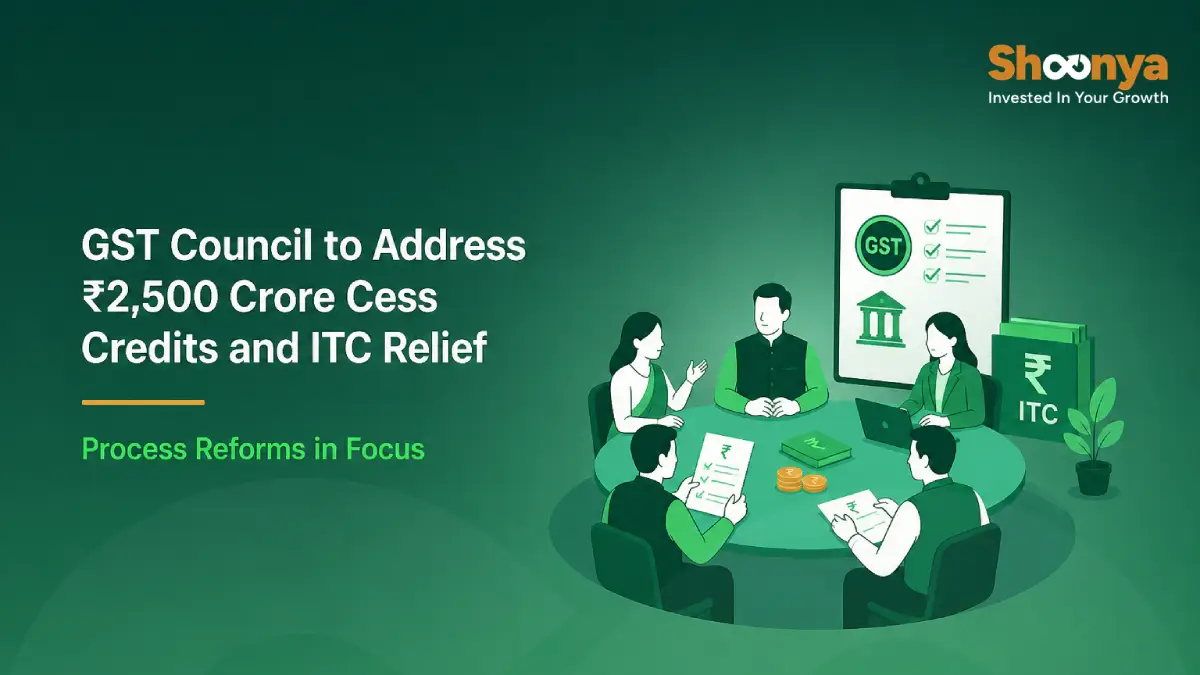
The GST Council meeting scheduled for October 7 will focus on process reforms under the indirect tax regime. Finance Minister Nirmala Sitharaman said in a LinkedIn post that proposals before the Council cover registration, returns, refunds, disputes, and smoother input tax credit flow, aiming to lower compliance time and cost.
GST Collections Show Consistent Growth in 2026
Sitharaman pointed to recent revenue numbers to underline the system’s resilience after the September 2025 rate restructuring.
| GST Indicator | Period | Figure |
|---|---|---|
| Gross GST collections | April-September 2026 | ₹12.46 lakh crore |
| Year-on-year growth | April-September 2026 | 11.6% |
| Collection acceleration | June-September 2026 | Nearly 15% |
| Reported taxable supplies growth | October 2025-July 2026 | 25.8% |
Every month from June to September recorded double-digit annual growth, and the four months combined accelerated by nearly 15%.
Why Input Tax Credit Access Is the Biggest Business Demand?
Businesses want to claim input tax credit when they hold a valid invoice, even if the supplier has not deposited the collected tax with the authorities. Under the current framework, a buyer can face denial of ITC due to supplier non-compliance, even when the purchase is genuine.
The October 7 meeting follows the September 2025 move from a four-slab to a three-slab GST structure, which was aimed at reducing classification disputes and compliance friction.
Why Auto Dealers Have ₹2,500 Crore Stuck in Cess Credits
Auto dealers purchased inventory from original equipment manufacturers by paying GST plus compensation cess of 1-22%. When the compensation cess was discontinued in 2025, around ₹2,500 crore of input cess credits became locked in electronic ledgers.
Under normal GST rules, cess paid on inventory could offset tax on fresh sales. Since compensation cess no longer exists, those credits cannot be applied to current GST liabilities. Existing statutory provisions also do not allow a cash refund. Industry is asking for a time-bound mechanism to either utilise or refund these stranded balances.
Decriminalisation May Be a Major GST Council Meeting Item
The Council may deliberate on whether tax authorities should retain arrest powers under GST. Under Section 69 of the Central GST Act, a Commissioner can authorise an arrest when there are reasons to believe a person has committed specified offences under Section 132, including:
- Fake invoicing
- Fraudulent input tax credit claims
- Fake refunds
- Deliberate tax evasion
One proposal under discussion is to remove GST’s standalone arrest provisions, which would eliminate the Section 69 route for a GST officer to arrest a taxpayer during an investigation.
What Registration and Litigation Reforms Are on the Table
On registration, businesses have sought:
- A guided single-attempt application process with tailored document lists
- Carry-over of data from an existing GSTIN
- Simultaneous multi-state registration applications
- Automatic jurisdiction allocation
- Risk-based and time-bound approval for larger low-risk businesses
On litigation, industry has asked for:
- A bar on notices where the tax demand is below ₹10,000
- Clearer guidelines for drafting and serving notices
- A distinction between fraud or suppression and bona fide short payment
- Mandatory personal hearings and speaking orders
Export Relief for GCCs Is Part of the Agenda
The Council may also address a tax treatment issue affecting global capability centres, or GCCs, which are India-based units of multinational companies carrying out engineering, product development, and testing for overseas group companies. These units are typically paid in foreign exchange for their services. The tax treatment of such payments affects refunds and GST compliance, making this a significant issue for India’s services export sector.
Final Outlook
The October 7 meeting is shaping up as a process-reform exercise covering decriminalisation, ITC access, stranded cess credits, litigation thresholds, registration changes, and GCC export relief. For businesses, the key developments to watch are whether the Council advances structural relief on arrest powers, provides a resolution mechanism for the ₹2,500 crore cess credit backlog, and moves toward broader ITC access for genuine taxpayers.
Source: Moneycontrol


Explore Our Offerings

Stocks
Trade equities across NSE and BSE with zero delivery charges. Invest, hold or sell with a seamless experience.


Future & Options
Execute complex strategies with simple tools and real-time data.

IPOs
Apply to the latest IPOs in just a few taps. Stay updated and capture opportunities as they open.