


September 16, 2026

September 18, 2025
September 10, 2025
July 3, 2025
UPI MDR: 96% of Merchant Transactions Unaffected, What Changes Above ₹2,000

Author
Shoonya Team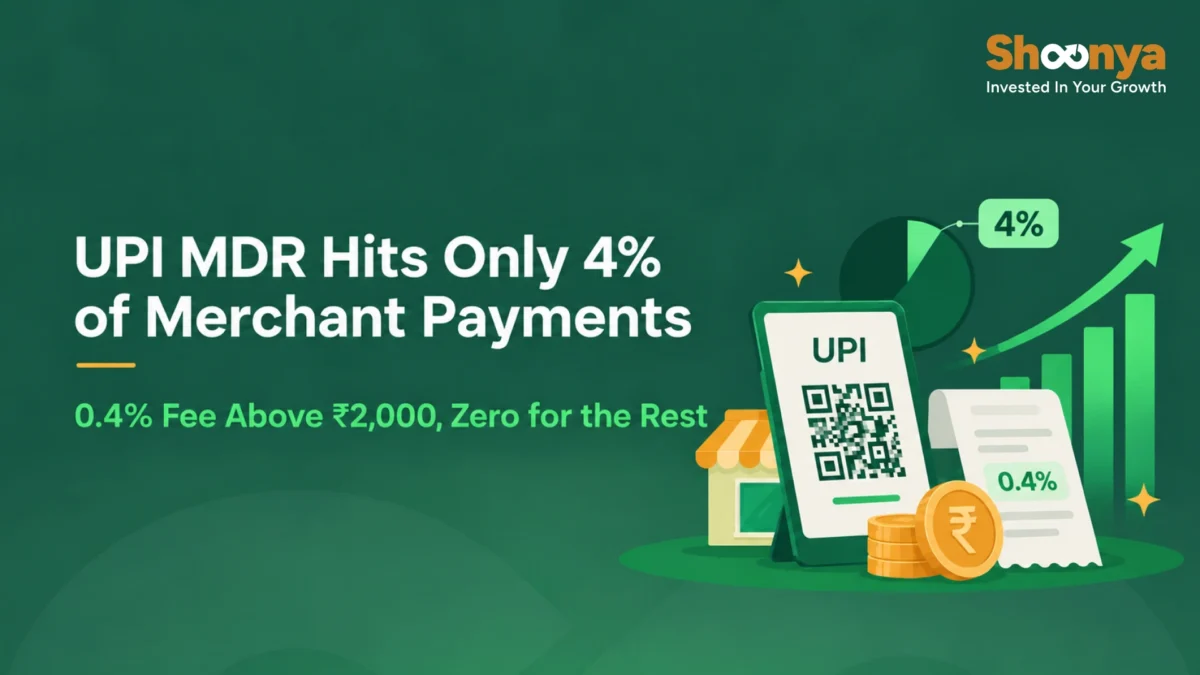
Around 96% of UPI merchant transactions will remain unaffected by the introduction of the Merchant Discount Rate, with the charge applying only to specified person-to-merchant transactions above ₹2,000.
What the MDR Structure Looks Like
The normal MDR for eligible transactions above ₹2,000 is 0.4%, with a maximum charge of ₹300 for transactions of ₹75,000 and above, according to NPCI. Essential sectors including railways, telecom, insurance, fuel, and agricultural inputs will attract a flat ₹5 MDR above ₹2,000.
| Transaction Type | MDR Treatment |
|---|---|
| P2P payments, any amount | Zero MDR |
| P2M payments up to ₹2,000 | Zero MDR |
| Small merchants receiving up to ₹1 lakh a month via UPI QR | Zero MDR |
| RuPay debit-card transactions | Zero MDR |
| P2M payments above ₹2,000 (eligible transactions) | 0.4%, capped at ₹300 |
| Railways, telecom, insurance, fuel, agri inputs above ₹2,000 | Flat ₹5 |
Sources said 96% of all UPI merchant transactions fall below ₹2,000 and will carry zero MDR.
Does the Customer Pay MDR?
The customer does NOT pay MDR.
Banks have been advised to ensure merchants do not pass the charge on to customers. MDR is a merchant-side cost, not a consumer levy.
Where Does the MDR Money Go?
For eligible UPI merchant transactions, the MDR is divided among participants in the payment ecosystem. The government share is zero.
| Recipient | Share of MDR |
|---|---|
| Issuing bank (customer’s bank) | 40% |
| Merchant acquirer | 30% |
| UPI app or TPAP | 20% |
| Payer PSP bank | 10% |
| Government of India | 0% |
How MDR Works on a ₹5,000 Transaction
For a ₹5,000 eligible UPI merchant transaction, a 0.4% MDR works out to ₹20 for the merchant. By comparison, a credit-card transaction carrying a 2% MDR on the same amount would come to ₹100.
The product price does not change with the payment method: the Same MRP, Any Mode principle. Merchants have historically absorbed debit-card MDR within the same MRP.
Why MDR Is Being Introduced Now
The stated objective is to create a sustainable revenue model for UPI as its scale and infrastructure requirements grow. The move is intended to make India’s UPI ecosystem financially sustainable over the long term and to fund servers, payment infrastructure, cybersecurity, fraud prevention, and customer support.
It also aims to expand UPI deeper into rural and semi-urban India and develop products such as Credit on UPI, UPI 123Pay, and other payment services. India had 55.49 crore UPI users as of June 2026.
The decision followed deliberations in the UPI and Services Steering Committee, which includes banks and other stakeholders. Sources also pointed to the Parliamentary Standing Committee on Finance’s March 2026 report, which called for a viable revenue mechanism to ensure UPI’s long-term financial sustainability. Opposition party MPs were present, according to the material shared.
How UPI MDR Compares With Card Charges
MDR is not unique to UPI. Merchant payment charges already exist across credit cards, Visa and Mastercard debit cards, and payment systems globally.
| Payment Method | MDR Rate |
|---|---|
| UPI P2M above ₹2,000 | 0.4%, capped at ₹300 |
| Credit cards | 1.5-3%, uncapped by RBI |
| Debit cards at physical POS (small merchants) | 0.40% |
| Debit cards via QR (small merchants) | 0.30% |
| Debit cards at physical POS (other merchants) | 0.90% |
| Debit cards via QR (other merchants) | 0.80% |
| RuPay debit cards | Zero |
For credit cards, MDR is typically 1.5 to 3% of the transaction value and is not capped by RBI; the rate is determined through market contracts between merchants and acquiring banks.
How India’s UPI MDR Compares Globally?
Merchant fees on instant digital payments are common globally. India’s 0.4% rate is among the lower end of global benchmarks:
| Country | System | MDR Range |
|---|---|---|
| Switzerland | TWINT | 1.3% |
| Thailand | PromptPay | 1.5-1.8% |
| Poland | BLIK | 0.7-1.4% |
| Philippines | QR Ph | ~1.0% |
| Spain | Bizum | 0.4-0.9% |
| Singapore | PayNow | 0.4-0.65% |
| China | WeChat Pay / Alipay | 0.38-0.60% |
| Indonesia | QRIS | 0.3-0.7% |
| Brazil | Pix | ~0.30-0.35% |
| Malaysia | DuitNow QR | ~0.25% |
| India | UPI | 0.4%, capped at ₹300 |
Final Outlook
The UPI MDR framework keeps most transactions at zero cost while introducing a modest charge on higher-value merchant payments to fund infrastructure sustainability. How merchants, payment apps, and banks adapt to the new structure, and whether the charge remains fully absorbed within the ecosystem without passing through to consumers, will be the key developments to watch after the October 15 rollout.
Source: Moneycontrol


Explore Our Offerings

Stocks
Trade equities across NSE and BSE with zero delivery charges. Invest, hold or sell with a seamless experience.


Future & Options
Execute complex strategies with simple tools and real-time data.

IPOs
Apply to the latest IPOs in just a few taps. Stay updated and capture opportunities as they open.